



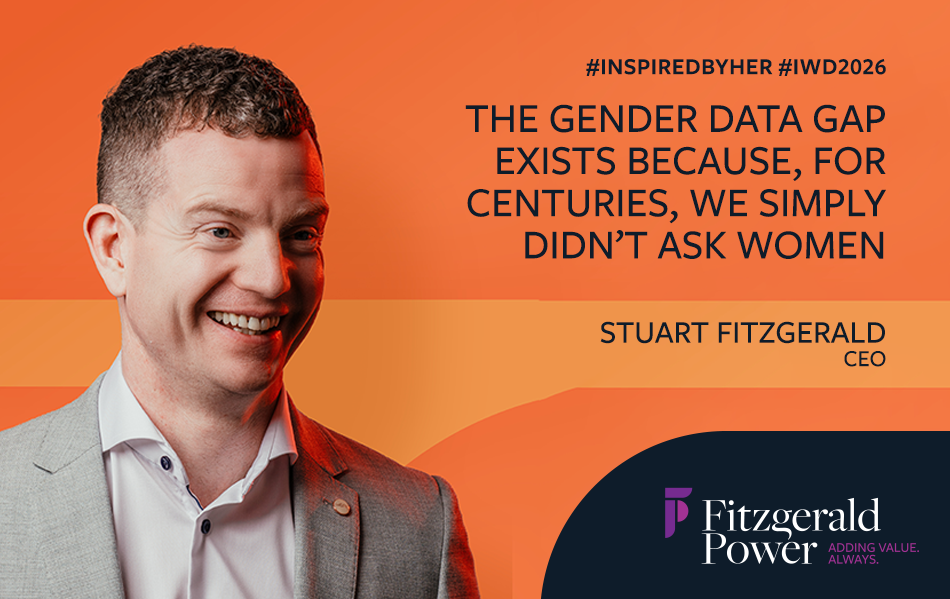

When the marketing team asked me to contribute to our Inspired by Her campaign for International Women’s Day and to name a woman who had influenced my thinking, I immediately thought of Caroline Criado Perez. Her book Invisible Women introduced me to the concept of the gender data gap, an idea that fundamentally changed how I see the world.
The central thesis is very simple. The lives of men have been taken to represent the lives of humans overall and as a result most of recorded human history is one large data gap. When it comes to the other half of humanity, the silence is often deafening. This absence of data – the failure to count, measure, and analyse the female experience – is what Perez calls the gender data gap.
If you want to understand inequality in modern society, you could do worse than starting here.
I have three smart, thoughtful children – two daughters and a son. And like most parents, I hope they all get the chance to reach their potential
But it seems unfair to think that the world is likely to provide my son with unfettered access to opportunity because he is a white male, while my daughters may have to fight for their place in it. Yet the data suggests precisely that.
Here are a few takeaways that struck me.
The Male Default
Women make up half the population, yet the female perspective is routinely treated as niche. The “default human” across medicine, economics, urban planning and technology is male – often white and middle-class. Everything else is a deviation.
The inequalities that result are not always the product of malice. Or as Perez puts it; “One of the most important things to say about the gender data gap is that it is not generally malicious, or even deliberate. Quite the opposite. It is simply the product of a way of thinking that has been around for millennia and is therefore a kind of not thinking. A double not thinking, even: men go without saying, and women don’t get said at all. Because when we say human, on the whole, we mean man.”
She cites an example where Google’s image-recognition software labelled a portly, balding, middle-aged man standing in front of a kitchen stove as “female”. Kitchens, it would seem, are a more powerful indication of gender than male-pattern baldness.
When the data is skewed, so are the conclusions.
Equality Is an Economic Issue
We often frame gender equality as a moral issue. Which it is, but it is also an economic problem.
When half the population is underrepresented in decision-making, the resulting policies, products and processes are less efficient. Markets are misread, talent is misallocated, and productivity is constrained.
Women do the vast majority of unpaid work globally – childcare, eldercare, housework. Much of the value that this work creates is invisible. But it has a value.
We tend to value what we can measure. It’s just easier.
But here’s one we can definitely measure. Women are more likely to have career breaks, so their chronological age is often older than their academic or professional age. Promotion systems and tenure clocks often fail to account for this. And that’s before you start to consider how difficult it is to re-enter the workforce after a sustained absence.
Representation Matters
In politics, balanced representation leads to more balanced legislation. When women enter legislatures in meaningful numbers, policy priorities shift – often towards health, education and social welfare.
The use of all-women shortlists by the UK Labour Party dramatically increased the number of female MPs over time. Representation changed because the mechanism for selecting candidates changed.
Contrast this approach with commentary during the 2016 US presidential election campaign where some voters suggested that Hillary Clinton was too ambitious. Running for the most powerful political office in the world undoubtedly requires ambition. Yet a reality television star with no political experience wasn’t criticised for the same trait. The difference was not ambition it was social norm violation. We associate leadership with men, and through this lens Trump was a better fit. Although history is unlikely to record it as such.
Closing the Gap
Perez’s solution is to close the representation gap, increase female participation in all spheres of life and collect gender-disaggregated data. Then analyse the data and act on it.
As more women move into positions of influence, different questions get asked. Gaps in previously held universal truths are exposed, and new ways of thinking are developed.
Sigmund Freud once posed a riddle about femininity.
“The great question,” he said, “that has never been answered, and which I have not been able to answer, despite my thirty years of research into the feminine soul is: What does a woman want?”
The answer, as Perez points out, was staring us in the face all along.
All “people” had to do was ask women.