



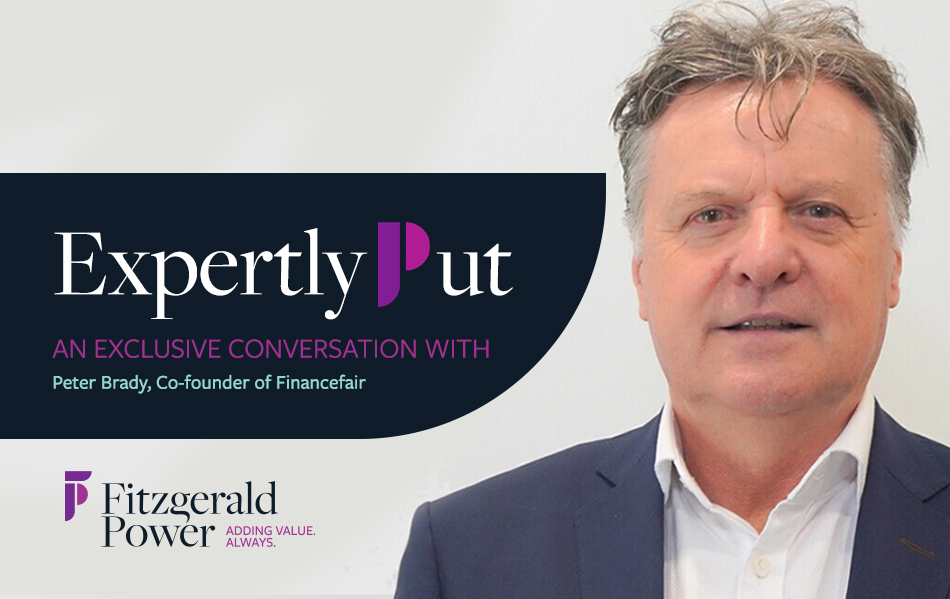
Expertly Put is a series of exclusive conversations with industry experts, designed to help business owners and management teams gain a deeper understanding of the topics that matter most. In this edition, Fitzgerald Power’s Corporate Finance Partner, Noel Winters, sat down with Financefair co-founder, Peter Brady, as he reflects on the company’s journey since its founding in the aftermath of the global financial crisis, how SME funding needs have changed, and how data-driven lending is helping bridge structural gaps in the Irish finance market.
Noel starts by asking Peter to give a brief overview of Financefair’s decade supporting Irish SMEs as the funding landscape continues to evolve rapidly.
Noel Winters (NW):
2025 was Financefair’s tenth year in business, congratulations! Tell me about Financefair’s early days, and journey over the past ten years.
Peter Brady (PB):
Thanks very much, Noel. Last September we marked our ten-year anniversary. Ff started by solving a very simple problem – post GFC lots of great businesses were being underserved by traditional banks, it was easier for Banks to say no rather than look at how they could support their growth. My Co-Founder, Helen Cahill, spent her career on the Treasury side of banking helping SMEs manage FX & interest rate risk – my background was in Finance – but from the other side of the fence. So, we had both seen first-hand how good businesses struggled to access growth funding. That was the genesis what was then called InvoiceFair a Platform that connected SMEs with institutional capital via Technology. We began with a single product: single invoice funding. From my previous experience using invoice discounting with banks, I understood the restrictions around concentration and geographies. If a business had a small number of large customers, or customers overseas banks often restricted funding. We took a different approach and focused on funding individual invoices instead of the entire debtor book. That reduced friction for businesses and gave them access to more flexible and larger amounts of funding.
Over the last 10 years, we’ve evolved significantly – diversified our funding base, innovated our product offering, leveraged the power of data in underwriting and monitoring and built institutional-grade risk processes.
NW:
From being in business ten years and looking at SME Ireland daily, what differences are you seeing in SME Ireland over that period, and what are the main challenges that you are seeing for business owners?
PB:
One of the main things that has changed is how businesses generate revenue. Previously, businesses relied heavily on invoicing and waiting for payment. Now, many businesses have shifted towards predictable recurring revenue models. . These provide more certainty and predictability and ultimately drive more value in the long term.
The growth of technology businesses has accelerated this shift. Many modern businesses don’t have physical assets to pledge the ones that banks traditionally lend against. Lending has become more focused on cash flow and revenue generation rather than physical collateral. For Funders like us, this means understanding the drivers behind revenue and understanding, early on, how the business works. Our products developed as this landscape evolved where businesses shifted towards recurring revenue models and scaling business in sectors that were asset-light but growing quickly.
NW:
And that leads us on to due diligence. Describe the typical due diligence process for Financefair. What kind of data points do you examine before extending credit?
PB:
An important part for us is the use of technology and data tools to get as much information as early as possible before you have a discovery call with the clients. The most crucial part of the call, however, is understanding how the business works. How does the company generate revenues ? How will the company be profitable? How will the company grow their business, what are the levers and do the management team have the capability to deliver that growth?
Once we understand the business model and the management team and we identify the risks and mitigants, we then use technology to access financial data. This includes read-only financial integrations – open and accounting banking data along with credit rating agency data. Open banking data has been a game changer for us because it gives real time visibility into cash flow, which is critical for assessing and monitoring risk. We also analyse the context behind financial metrics. For example, a balance sheet item might look negative, but on review could represent quasi-equity rather than debt.
NW:
From my experience, pillar banks use traditional metrics such as a three-year track record when assessing businesses. That track record is not there for early-stage businesses. What do you look at in those scenarios?
PB:
For early-stage businesses, we focus heavily on clarity of the business plan, quality information and operations readiness. Then we look at customers – the most important asset a company has, and banks often overlook this. We look at customer quality and mix , sales pipeline, conversion timelines, and the strength of uniqueness of the value proposition strength.
For revenue-based finance, we typically fund based on predictable recurring revenue. Funding increases as revenue grows, which reduces risk and aligns funding with business performance. It’s all about landing those early customers and having total focus on the revenue number month on month.
NW: The term ‘alternative lending’ is often used to describe the type of finance that Financefair provides, what does this mean?
PB:
Alternative lending is generally understood as non-bank lending. It is typically faster and more flexible than traditional bank funding. From our perspective, it gives access to diversified funding. The advantage of that is you’re able to take on board different risks; banks usually lend from their own balance sheet, which limits risk. In our model, we can match different risks with different funding sources and spread that risk across multiple funders. This diversification allows us to support businesses that may not fit traditional lending models. Ireland has a structural gap in SME funding due to limited banking competition. Data-driven lending and diversified funding sources help to address that gap.
NW:
Financefair’s model is gearing towards relatively early stage and scaling businesses, therefore, a riskier profile of lending. Do you experience much default within your portfolio?
PB:
I’d love to say, no, we get everything right. Our default rate has been very low, typically below 0.5%. This is not because we’re brilliant at underwriting. It’s all about the relationship and the understanding of KPIs in each of those businesses, which signal performance changes early. These might include customer churn, return on advertising spend, or operational metrics. For example, I worked with someone in manufacturing who tracked waste by how often they replaced scrap bins. That single metric gave them early visibility into production issues. So, that’s how we manage those types of risks. It’s all about openness and transparency.
We monitor a small number of meaningful KPIs for each business. This allows early intervention if performance begins to change. The strength of the balance sheet is not why a business fails. Good businesses fail only for one reason: they run out of cash. Understanding cash flow and business drivers is critical to managing risk.
NW:
Are you seeing any trends developing in any sectors regarding credit appetite?
PB:
I see a lot of Irish businesses in the data centre space that are doing well in the Nordics and Northern Europe. There’s a lot of growth in that area. The credit underwriting is very different from what’s typical in Ireland, because there are a lot of other risks in those countries such as very strong unions. You need to make sure you’re on side with union agreements, deductions and pay rates. That’s something you must be able to get access to and to be able to underwrite.
Irish businesses are becoming increasingly international, particularly in sectors like technology, data infrastructure and MedTech. We have funded a lot of companies that got traction in the US so it will be very interesting to see what happens now in the US market during the Trump regime.
NW:
Have you seen any changes in that environment?
PB:
The only changes we’ve seen were the introduction of tariffs at an early stage. It was interesting for us from a risk perspective. You can look at your portfolio and think there’s no problem there, but you really need to understand the supply chain and the impact of tariffs, and you need to understand how easy it is for them to disintegrate. Can you easily move somewhere else where tariffs might be lower? This is something we are much more aware of.
NW:
What does the future hold for Financefair?
PB:
Our primary focus is on growth and on broadening and deepening our funding mix so that its competitive, but also flexible – enabling us to meet the needs of scaling businesses in 2026. We’ve recently added two European banks, and we have a lot of institutional funding on the platform as well. As we scale, we can support large and more price sensitive SME requirements.
We also want to continue providing fit-for-purpose funding. Traditional funding products have not changed significantly over time. Our focus is on adapting funding to match modern business models and revenue structures.
NW:
If you were to offer one piece of advice to someone starting their scaling journey, what would that be?
PB:
I think the most important thing is to focus on business growth rather than fundraising. I’ve seen young, smart entrepreneurs focus too heavily on raising large amounts of funding early when what they should be doing is looking to get a funding line that is directly related to their growth.
When businesses focus on building revenue and profitability first, they often make better decisions. They also retain more ownership when they eventually raise equity funding, because their valuation is higher.
Fundraising is a huge diversion of time and it’s not what a business starting out should be concentrating on. It’s about getting your message, your products and your channels in place.
Until next time.
Financefair was founded by Helen and Peter, combining deep experience from both sides of the funding challenge to solve one of the biggest problems facing growing businesses: access to working capital. Frustrated by how often potential was being held back by inflexible funding, they set out to build something better. For more information, go to Financefair’s website here.