



What your morning coffee says about the economy
Three quarters in and our morning coffee is starting to tell an interesting story.
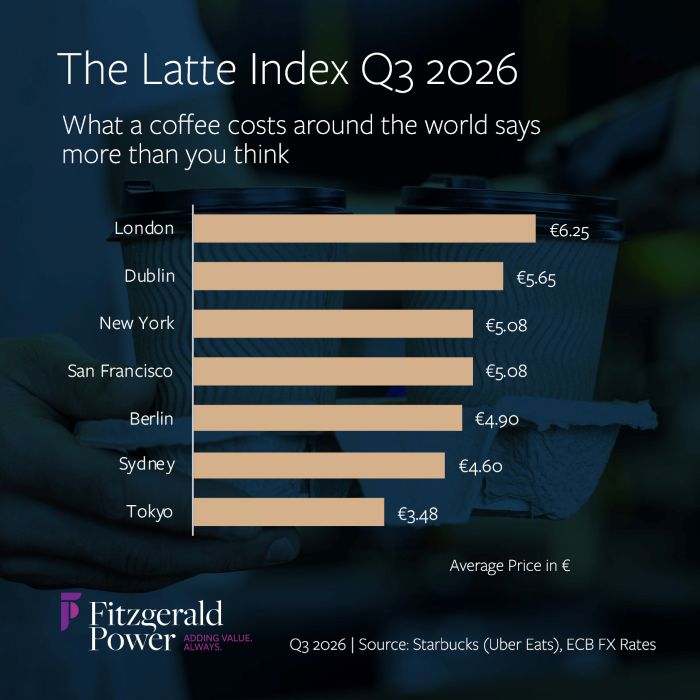
The Fitzgerald Power Latte Index tracks the price of a standard Starbucks Tall Latte across seven major global cities, giving us a light-hearted look at how prices are moving around the world.
And in Q3, there was finally a little more movement.
London pushed further ahead. San Francisco bounced back sharply. Dublin? Dublin didn’t budge.
So, what can we learn from our latest trip to the coffee counter?
Q3 2026: Prices Are Moving Again – Just Not Everywhere
After a relatively quiet Q2, our latest Latte Index shows prices beginning to move again.
London remains the most expensive city in the index, rising 4.11% from €6.00 to €6.25. San Francisco recorded the biggest quarterly increase, climbing 12.64% to €5.08, while New York edged up to €5.08.
Sydney and Tokyo also recorded modest increases, while Berlin remained unchanged at €4.90.
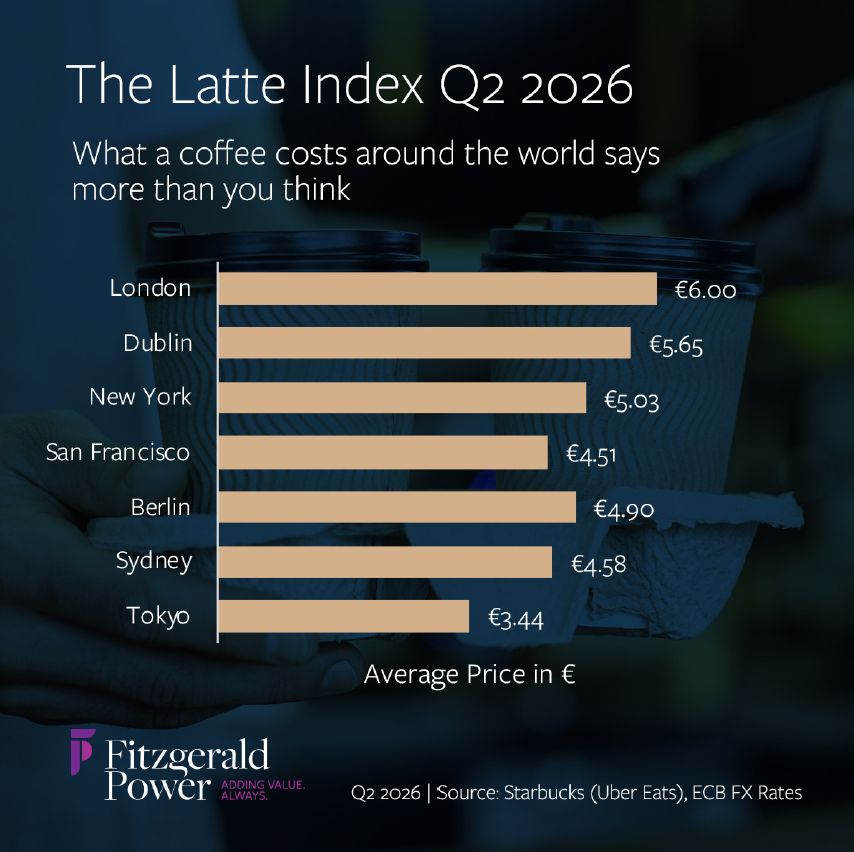
Across all seven cities, the average price increased from €4.87 in Q2 to €5.01 in Q3, bringing it broadly back to Q1 levels.
So, after a quarter where the story was how little prices moved, there’s a little more life in the coffee market. Although anyone hoping for noticeably cheaper caffeine may want to keep the kettle handy.
Dublin: €5.65. Again.
If consistency deserves a prize, Dublin may have earned it.
A Tall Latte remains €5.65 for the third consecutive quarter, leaving Dublin as the second most expensive city in our index behind London.
The lack of movement is arguably as interesting as an increase.
While prices elsewhere fluctuate, Dublin’s €5.65 benchmark appears remarkably sticky – a useful reminder of the persistent pricing environment facing both consumers and businesses in Ireland.
The coffee hasn’t become more expensive.
Unfortunately, it hasn’t become any cheaper either.
London Extends Its Lead
London already held the top spot. In Q3, it stretched its lead.
The price increased from €6.00 to €6.25, a quarterly rise of 4.11% and up from €5.93 when we began tracking prices in Q1.
That leaves a 60-cent gap between London and second-placed Dublin and reinforces London’s position as the most expensive city in the Latte Index.
Apparently breaking the €6 barrier in Q2 wasn’t enough.
San Francisco Bounces Back
The biggest movement of Q3 came from San Francisco.
After falling from €5.00 in Q1 to €4.51 in Q2, its latte price rebounded to €5.08 in Q3 – an increase of 12.64%. Its local price returned to $5.85, the same level recorded in Q1.
That context matters.
As we noted last quarter, the Latte Index uses platform-based pricing, so individual store prices, promotions and platform dynamics can influence quarterly movements. The San Francisco figures reinforce why one quarter’s movement is interesting, but the longer-term pattern tells us considerably more.
New York provides a good comparison. Its euro price increased slightly from €5.03 to €5.08, while its local price remained unchanged at $5.85.
Sometimes the exchange rate deserves some of the credit – or blame.
Elsewhere: Steady As It Goes
Away from the larger movements, much of the index remained relatively settled.
Berlin held at €4.90, while Sydney edged from €4.58 to €4.60 and Tokyo moved from €3.44 to €3.48.
Tokyo therefore remains comfortably the cheapest city in the index, while Berlin has now recorded €4.90 in all three quarters.
Taken together, the figures show why individual quarterly movements need to be viewed as part of a wider picture.
What Does Q3 Tell Us?
The Latte Index isn’t an official measure of inflation – nor are we suggesting economists abandon their spreadsheets for coffee menus just yet.
But everyday prices can provide a useful window into the pressures being felt by consumers and businesses.
After very little movement in Q2, the average price across our seven cities has risen again. Yet the picture isn’t uniform: some markets are moving, others remain almost stubbornly consistent.
For Irish businesses, Dublin’s three-quarter run at €5.65 is perhaps the most interesting example.
Prices don’t necessarily need to keep rising for cost pressures to remain significant. Sometimes the fact that they aren’t coming back down tells its own story.
Looking Ahead
Three quarters down, and a few patterns are beginning to emerge.
London continues to pull away at the top.
Dublin refuses to move.
San Francisco has returned to where it started.
And Tokyo remains the place to go if your economic strategy is based entirely around finding a reasonably priced latte.
We’ll be back with the Q4 Fitzgerald Power Latte Index to see whether prices finally begin to settle – or whether there’s another surprise brewing.
Because sometimes the economy is easier to understand when it’s served in a cardboard cup.