



“There’s a role for every sector”
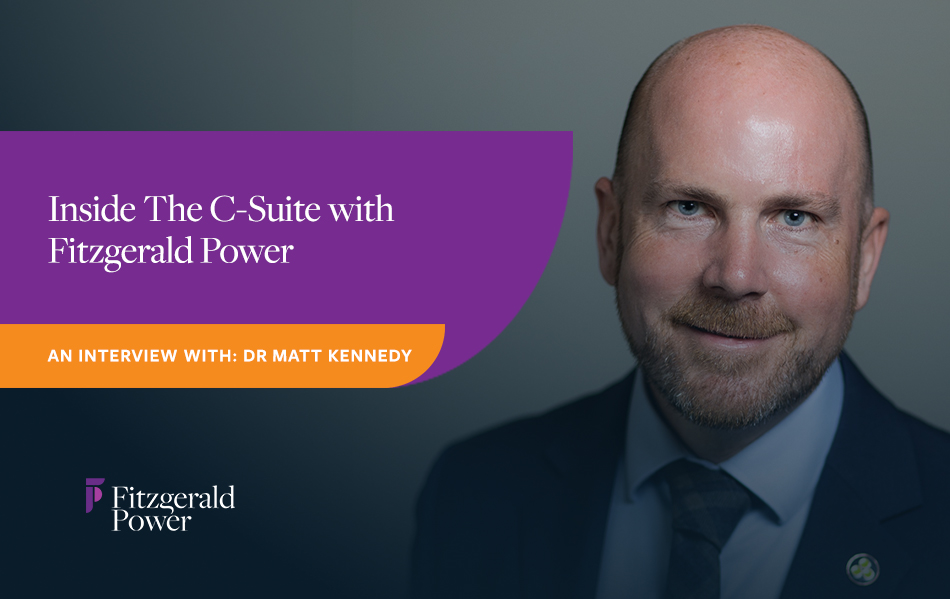
In Fitzgerald Power’s interview series, we’re speaking to people with different perspectives who feel they can offer more to the workplace, from the water cooler all the way up to the C-Suite. Today, it’s Dr. Matt Kennedy, the Global Head of Client Transformation, from the Industrial Development Agency (IDA) Ireland on how choosing sustainable practices within your business model does as much for your earnings as it does for the planet.
Matt Kennedy has certainly been around the block. A chartered environmental professional and energy engineer with over 25 years’ experience in delivering national and international transformation and climate change initiatives, Kennedy has built a career in providing policy advice and thought leadership for clients, resulting in a global reputation. “The main functions I oversee are support to Foreign Direct Investment (FDI) clients in Ireland, under the four briefs in my portfolio: R&D, Sustainability, Talents and Skills and Digital. It’s really about the existing clients within Ireland and helping them to transform; become more innovative, decarbonise, build more resilience in the business, and all the things that you’d expect.”
An internationally recognised expert when it comes to developing policy advice across governments and providing advice to businesses, we begin by asking him what the biggest hurdle is for those looking to integrate sustainable initiatives into their business. It tends to be more than one, he says. “What I would say is that there’s a real focus on decarbonisation,” he says. “Because there is a price on carbon, manufacturers can justify the financial investment – as they get the economic and environmental benefit – in addition to resilience across their business. Some challenges exist for services-type companies, whether FDI or indigenous, that don’t own their own buildings. So encouraging businesses to deliver adaptive measures and to deliver circularity measures can deliver value for all companies.”
Sustainability, in business terms, tends to be talked about in the wrong way. Most of the time, people apply a boundaried lens to it, considering merely the carbon footprints and/or recycling bins. Much of Kennedy’s job is about highlighting the bigger picture, such as resilience through a changing world, or creating a hospitable environment for FDI. “I’ve been in the sustainability business for 25 years,” he smiles. “And it’s been called different things throughout that time. At the moment, a major hook from the sustainability side is how companies link themselves to competitiveness and productivity, and become more sustainable in a way that delivers benefits and value to the business. You could argue that there’s always been a need for an economic driver as well as a social and environmental driver… But ultimately, at the moment, a lot of the focus now is on competitiveness as a narrative or a language or a buzz term, rather than social sustainability, ESG or compliance.”
So much has changed in recent years, he continues, that thankfully, more corporations than not are seeing the myriad benefits available to those thinking green. “A lot of the FDI clients in Ireland have climate pledges that are well in advance of what government pledges are. For example, Ireland, as a country, wants to be net zero by 2050, but a lot of the major FDI clients in Ireland want to be net zero by, say, 2042. So, you know, they’re very conscious that they need to report on their actions. Their shareholders are also expecting them to have sustainable operations, because it’s really good for their economic resilience. And I think that has really changed in the past 5-10 years. Back then, your sustainability officer was over on the left hand side of a business in an organisation structure. Now, an entire sustainability consideration is incorporated through the business and also providing economic value as well as upskilled employees.”
That said, there are challenges. “The main one being that some organisations don’t know where to start,” he says. “They’re also looking across their competitors to see what their competitors are doing, and sometimes they don’t want to be the first to move. So you have market challenges, return and investment challenges, but ultimately, those who are ambitious tend to embrace and deliver quite a large solution.”
Before the IDA, Kennedy worked at Arup, where he held the position of European Sustainable Development & Global Climate Strategy Leader, with previous experience from International Climate Consultancy, Tyndall National Institute and SEAI. Before that again, he was the lead EU negotiator at the Paris Agreement climate negotiations (COP21) and previously Chair of the UN Climate Technology Centre. “Nothing happens in the 10 or 14 days within COP,” he smiles. “I was responsible for technology transfer and trade, which ended up being Article 10 [of the Paris Agreement] for those really interested. And so the first thing about communicating across 27 Member States was to get clear agreement and lines. And that involves bringing people together, sharing what the red lines are and what lines of intersection are, and ultimately whether we could proceed.” A shrewd negotiator, much of Kennedy’s role focuses on communicating, often effectively, difficult subjects to global bodies. His best tip when it comes to effective communication? Leaving out the element of surprise. “The most important thing from the EU position, in advance of COP 21 in Paris, was to communicate to other regions what the EU position was, so that it didn’t become a surprise when you landed. That strategy bore great fruit because the EU then built alliances with like-minded regions that have the same goals. So rather than, you know, in a very strict poker game – our prisoner’s dilemma, as the negotiations are often called – the EU position was very frank and very clear from the start, especially around intellectual property, innovation and the importance of investment within southern hemisphere countries. You never really know who shares your ideals without expressing them in advance.
And that then led us to build great alliances with African states, Asian states, Latin American states, etc.”
While becoming a sustainable business isn’t a matter of just flipping a switch, it is worth the effort – particularly considering that consumers are increasingly aware of the impact of what they choose, buy and throw away. According to a 2020 McKinsey survey, up to 70% of respondents said they’d pay more for a product with sustainable packaging, and that number is only going one way. Kennedy, an eternal optimist, insists everyone has a part to play. “There’s a role for every sector,” he says. “That’s the first thing in terms of sustainability. Looking back, while environmental NGOs have had a strong stance on environmental integrity, it was corporations, including B-Corps, in the 80s that really pushed this forward. Now there may be scepticism, but ultimately, because of the major emissions that have occurred in the last 30 years, corporations now need to own and be responsible for their past and future emissions. Today, there is a significant role for corporations in avoiding greenwashing and gaining clarity on measurement and reporting for their transparency and accountability regarding emissions. We have come a long way in the last five years in terms of those standards, and mainstreaming those standards has become really important.”
Is it too late to start now? “I’m forever an optimist,” he says. “But time is of the essence. You know the decisions you make now in terms of infrastructure, fossil fuel infrastructure, and low carbon, will last for 30-40+ years. So we are running out of time to maintain targets for emissions reductions and broader greenhouse gas emissions, but we will not get there without action from industry. We will not get there without research informing our science from academia. And we will not get there without environmental organisations being the watchdog for such corporations to make sure that they act responsibly and are accountable for their own emissions reduction. Yeah, so everyone plays a role. I’d like to see it happening a little faster… but sometimes these corporations are very big ships. It takes a while for them to turn in the right direction.”
For more information on Dr Matt Kennedy’s work, check out his website here – https://matthewkennedy.org/.