



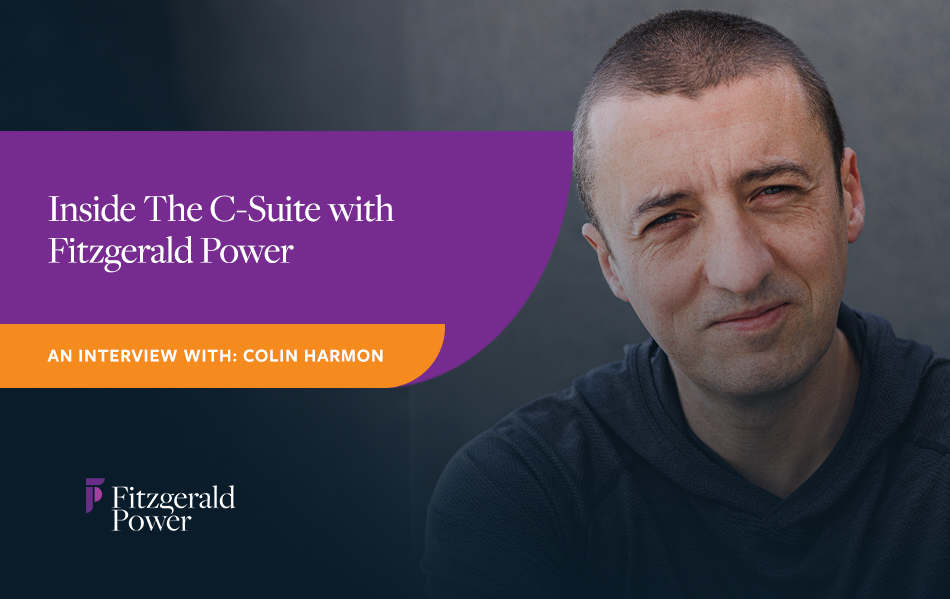
“If you want people to trust you, become an expert.”
In Fitzgerald Power’s interview series, we’re speaking to people with different perspectives who feel they can offer more to the workplace, from the water cooler all the way up to the C-Suite. Today, it’s Colin Harmon, founder and CEO of 3fe Coffee.
Eighteen years ago, Colin Harmon took a pretty big gamble. He made the decision to quit his job as an investment broker, sell his car, and pursue his dream of opening a coffee shop. A hospitality stalwart since his teens – jobs like McDonald’s on Grafton Street funded Harmon’s third-level education – he decided that the finance life wasn’t for him. “Probably boredom,” he laughs, citing the reason behind it. “I got a job working in investment funds, working mainly with regulations, and I got two years into that and sort of felt like I needed out.” At the time, the finance world was booming. “There was lots of money in that industry,” he says. “And lots of safety, too. People would regularly leave their jobs to go travel to places like South East Asia or Australia, and then get a bonus to come back. Because that was on offer, I decided to leave my job and try to do something I wanted to do. I told myself that if I couldn’t figure it out after a year, then I’d take my old job back. Then, three months in, the economy collapsed.”
Nevertheless, he persisted. So much so that one year to the day after Harmon left his job, he came fourth in the World Barista Championships. (This was after he’d secured the national title, one he’s since won three other times.) “It was a bit mad,” he smiles. “One of the judges told me afterwards that I shouldn’t tell people that, because the guy who won it had, like, 30 years of experience. So I think they were like, we can’t let this guy win, he’s only been at it a year.” Dublin at the time had practically no coffee culture, something that became glaringly obvious at the event. “Other teams from say the US or UK had sponsors, as well as someone to organise the cups, another to organise the beans,” Harmon says. Conversely, he arrived with friends to take a chance. He left with an impressive final result and an understanding of the growing power of speciality coffee worldwide. “You had 4000 people in tiered seating cheering for cappuccinos, it was mad.”
Harmon was born in Cork City, but spent most of his life in the capital. At university, he accrued a Business and Law degree as well as Fund Investment, Tax and “a few other finance-based courses,” all of which came in handy for a start-up in the thick of a recession. Not to mention a coffee start-up in a nation of tea-drinkers. The first iteration of 3fe – named for the simulator he built from his third-floor apartment to practice for competitions – came in by way of Middle Abbey Street’s Twisted Pepper nightclub (now Wigwam) with a loan of €5000 from Harmon’s father and a promise to the owner that he’d pay rent when he made some cash. Business hardly boomed. “The first day I sold 16 cups of coffee,” he laughs. “There were days where I stood for eight hours and sold nothing.” Filter coffee at that stage was a hard sell; it was often only ever ordered by the city’s baristas, who were typically too busy with their own work to visit the premises week-on-week. Bit by bit, however, Harmon figured things out. “Honestly, that’s how I’m still doing this – figuring little bits out day by day.” A year and a half later, 3fe’s flagship space on Grand Canal Street opened. “We ran the two spaces concurrently for about six months, then sold our gear to the then-manager of Twisted Pepper, who now runs Vice coffee, and started roasting. Roasting seemed like a much more scalable thing to do, and today roasting is the bigger part of the business.”
Today, Dublin’s speciality coffee scene is vast and varied, a shift many credit to Harmon and his peers. “I don’t think people realise it, but for such a small city, Dublin’s scene is quite astounding,” he says. “Like, you don’t see this calibre of places in New York, which is mad to say.” Those behaviour shifts started modestly, he says. “I remember a bit of resistance,” he says. “There was this article in one of the papers about how much a cup of coffee was in different cafés, which is mad because you’d never do that for, say, a glass of wine. People know there are so many variables at play. But at that stage, trying to convince people the same for coffee – that it tastes different from different places and is a seasonal product – was a huge part of it.” The main reason he believes that behaviour change was successful? “Honestly… just being nice to people.” He likens this to an analogy of a bookstore. “If you’re into books and you go into a bookshop for a certain one, and the guy behind the counter rolls his eyes at your choice, chances are you’re not going to go back. Engaging people, and bringing them on a journey, and as much as I hate the term, educating people, was really important for us in the early days. Because we’d often come up against people who were like, I’ve been drinking coffee a certain way all my life, why would I change that? But honestly… being nice was the way to do it.”
Today, 3fe has eight shops, “about 80” staff and an 8500sqft roastery in Glasnevin. Last year, they roasted about 250 tonnes of coffee for products shipped worldwide. The company also runs a subscription service, an online shop and hosts a series of workshops on making the perfect brew. As a result of their expansion, the business’s biggest customer is actually themselves. But increasingly domestic and international businesses and clients – “loads of Irish people living abroad” – call on their beans for their morning pick-me-up. A lot of this can be linked to Harmon’s own intellectual acumen; people trust his brand to be good because they know he’s put in the hours. “It’s easy to open a food business,” he says. “The barrier to entry is quite low. But whether it’s pizza or wine or burgers, you want people to trust you. When people see you as an expert in that field, they’re more likely to gravitate towards you. I enjoy getting right into the heart of something and devoting myself to it, and being able to leverage that. I just don’t think you should be a big player in something if you’re not in it completely yourself.”
Much has been written about the difficulties of running an SME in Ireland of late. In hospitality, the difficulties are more pronounced still. 3fe, according to Harmon, is protected from some of the harder parts because they’ve managed to scale, but he sees peers time and again unable to protect themselves because “the government is creating an environment that is more suitable to larger companies.” “All of our staff are paid more than minimum wage, but when minimum wage goes up, there’s an expectation that all wages go up, and that affects everything we do. It means all the prices of coffee have to go up, and then that means people stop having three coffees a day, and they’ll start having one… or that kind of thing. It’s a lot of stealth factors that people don’t realise. Construction, pension contributions, and insurance costs are all going up, and all of these things don’t impact big businesses in the same way.”
The consequences of that are tenfold, Harmon insists. “Small businesses are huge employers,” he says. “And even if people don’t want to work in coffee shops their whole life, they’ve often developed the skills to become excellent marketing people or sales people from their time there. It’s a great sense of learning, and I think the government needs to do more, because the environment is becoming very, very inhospitable.” This consideration colours the advice Harmon gives today, particularly towards those who look at his career change and subsequent success with rose-tinted glasses. “I’ve been very lucky,” he admits. “I’ve worked hard, but I’ve also been lucky. I think it’s the Irish Times that love the stories of somebody giving up their job to pursue their passion, but sometimes, you’re better off just keeping your hobby. Like, if it goes wrong, you can end up with a job as your hobby, and then you start hating your job, and you’ve got no hobby. Don’t presume that just because you’re passionate about something that will be a successful business. If you find the time and figure it out, that’s brilliant. But, yeah, I think the perception is that just because it’s your passion, it would make a great business. And unfortunately, that isn’t always true.”